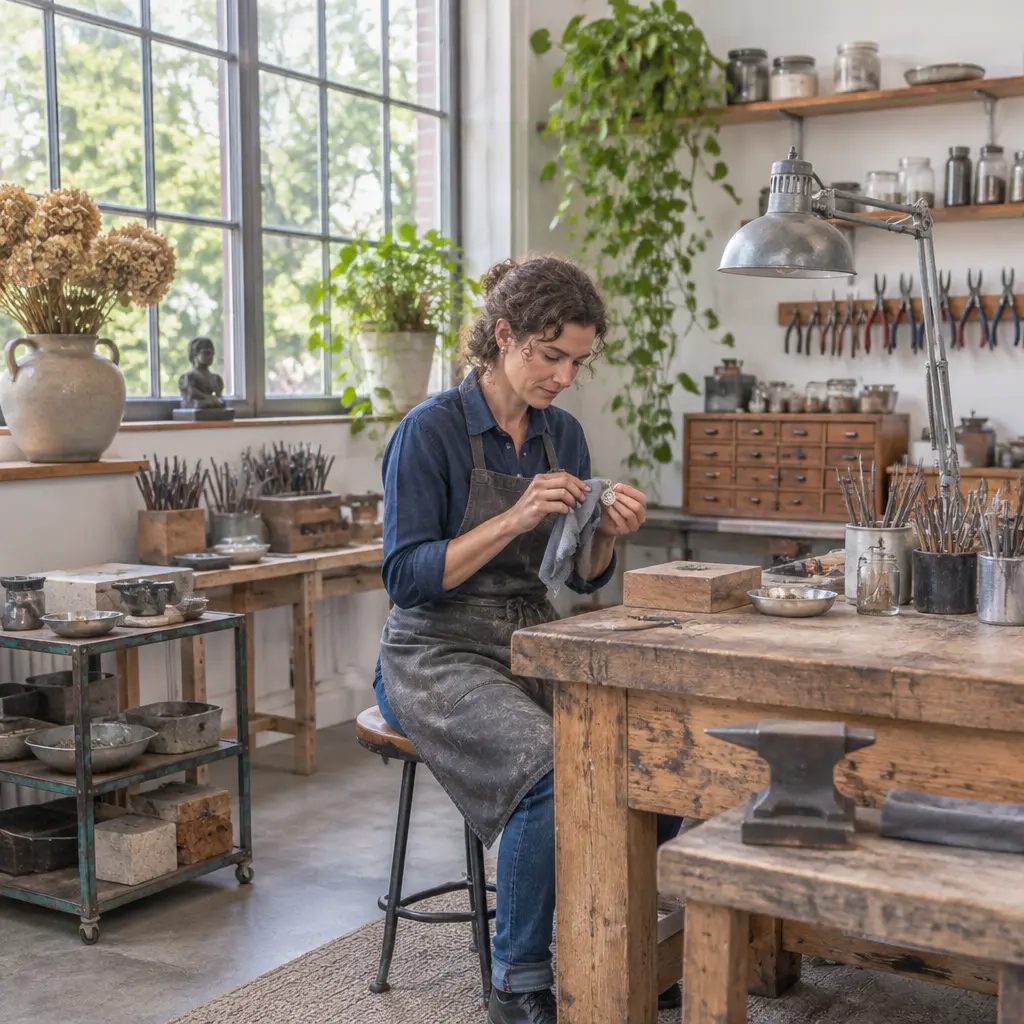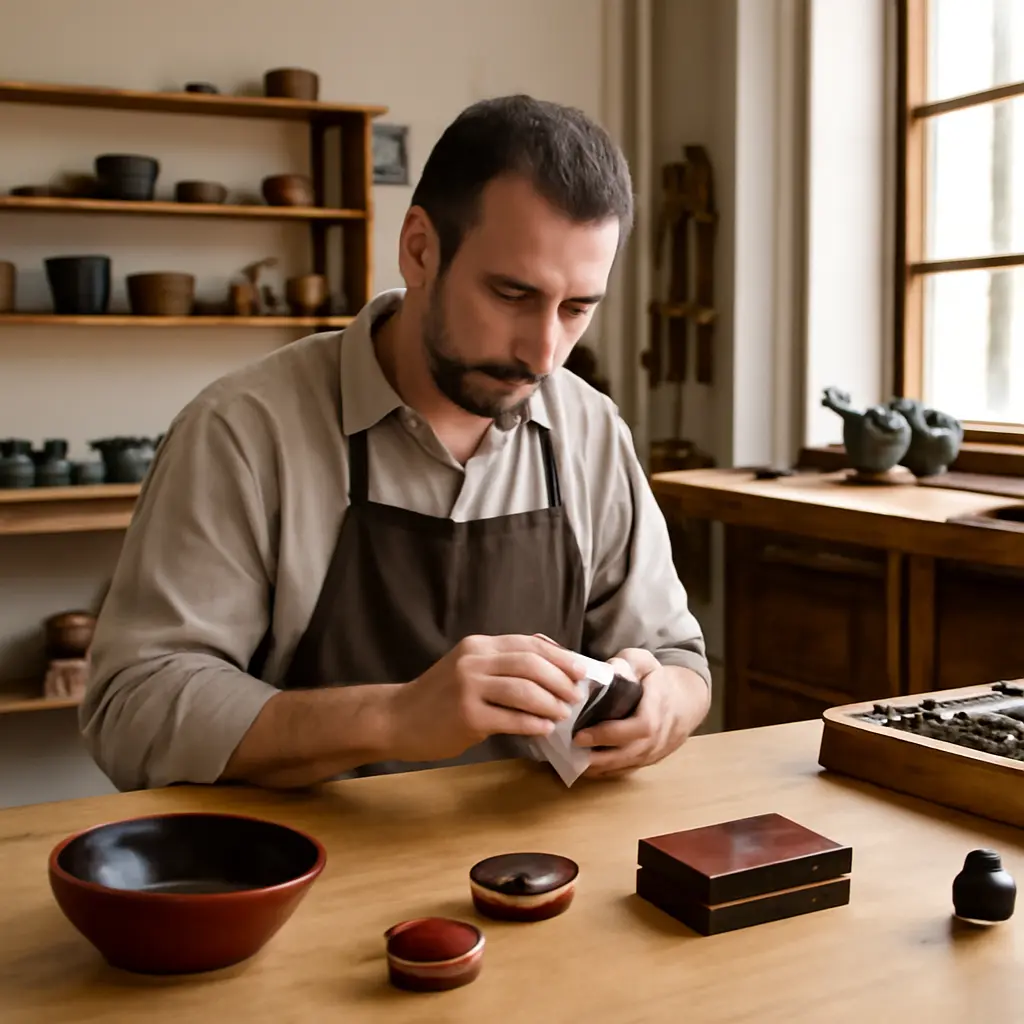
Lacquer is a durable, highly polished finish made from layers of natural or synthetic materials; in East Asian art, the term most often refers to coatings derived from the sap of the lacquer tree. Ancient lacquer methods still shape modern high jewelry because they established demanding standards for surface preparation, controlled layering, color depth, precision, and long-term care. From Chinese lacquerware dating back thousands of years to contemporary jewelry’s use of Japanese urushi and glossy lacquer-like finishes, the craft links historical expertise with present-day expectations for refined surfaces and meticulous handwork.
Ancient lacquer methods and the standards they established
Lacquer is not simply paint: it is a coating system built through repeated applications, drying or curing, and polishing. The Victoria and Albert Museum describes East Asian lacquer as a finish made from the sap of lacquer trees, especially Toxicodendron vernicifluum, also known as the Japanese lacquer tree. The resulting material can be exceptionally glossy, protective, and suitable for decoration with pigments, metal powders, carving, or inlay.
Archaeological discoveries show that lacquer technology developed long before modern jewelry houses adopted lacquer as a luxury surface. A lacquered wooden bowl excavated at the Hemudu site in China has been dated to approximately 5000–4500 BCE, according to the Zhejiang Provincial Museum and accounts of the find. The exact date and interpretation of early objects depend on archaeological context, but the evidence demonstrates that lacquer’s history reaches back more than six millennia.
The ancient process set enduring benchmarks: prepare the base carefully, build thin and even coats, control the environment, allow sufficient curing, and polish without damaging the layer beneath. These principles remain relevant to high jewelry, whether an artisan applies natural urushi to a component or a jeweler uses a modern lacquer finish. The shared standard is not that every contemporary product uses the ancient recipe; it is that a luxury surface must look deliberate, consistent, and durable under close inspection.
Natural urushi and its defining properties
Urushi is sap harvested from lacquer trees and refined for use as a coating. Its distinctive curing process relies on moisture and warmth rather than simple evaporation alone: the enzyme laccase helps polymerize the urushiol compounds in the sap. The Japan Kōgei Association and Japanese craft institutions describe this controlled curing as central to traditional lacquer work. Once fully cured, urushi forms a hard, resilient surface, though uncured sap can cause severe allergic skin reactions.
Traditional methods include roiro, a technique for producing a deep, polished black surface; maki-e, in which metal powder is applied to create designs; and raden, which incorporates thin pieces of shell. These are not interchangeable finishes: each requires a different sequence of coating, decoration, and polishing. Their technical variety helps explain why lacquer is treated as a specialist craft rather than a single decorative treatment.
Layering, curing, and surface control
Lacquer objects are commonly made through multiple thin coats, with drying, abrasion, and polishing between stages. The number of layers varies by object and method, so there is no universal coat count. What matters is the controlled build-up: a thick application can wrinkle or cure unevenly, while inadequate preparation can undermine adhesion and finish quality. Traditional workshops use dedicated curing cabinets, often called muro in Japan, to manage humidity and temperature.
This process anticipates the quality controls expected in high jewelry. A smooth surface must remain visually even around curves, edges, settings, and joins. The polish should not obscure the design or expose the substrate, and the finish must be assessed under direct light as well as ordinary viewing conditions. These are practical craft requirements, not merely aesthetic claims.
Lacquer techniques and their modern high-jewelry counterparts
In modern high jewelry, “lacquer” can refer to natural urushi, a lacquer-like resin coating, or a brand-specific decorative treatment. The material and process should be identified accurately: a glossy colored surface is not necessarily traditional urushi. This distinction matters for care, repair, provenance, and claims about heritage. The historical techniques offer a useful framework for understanding how contemporary makers manage color, reflectivity, and surface durability.
Color, gloss, and visual depth
Lacquer can provide saturated color and a reflective finish that contrasts with the sparkle of gemstones and polished metal. Traditional Japanese lacquer artists achieve depth by combining carefully prepared layers, pigments, and surface polishing; some decorative methods add gold or silver powder. In jewelry, the effect can make a small area of color appear unusually rich, while giving designers a counterpoint to diamonds, enamel, or colored stones.
The finish also changes how a piece reads at different distances. A glossy surface returns sharp highlights, while a more subdued or textured treatment diffuses light. This makes lacquer useful not only as decoration but as a design tool for controlling contrast and emphasis. However, the visual effect depends on the specific formulation and construction, so claims about colorfastness or scratch resistance should be tied to the maker’s disclosed materials and testing.
Lacquer, enamel, and other decorative finishes
Lacquer is often compared with enamel, but the two are different materials and processes. Traditional jewelry enamel is generally powdered glass fused to metal through high-temperature firing; lacquer is an organic coating that cures under controlled conditions. Enamel can be brittle and may chip if struck, while lacquer can be vulnerable to scratching, solvents, heat, or prolonged exposure to unsuitable conditions. Their performance depends on construction and use, so neither should be described as universally more durable.
Other related techniques include colored resins and modern polymer coatings. These may reproduce some of lacquer’s visual qualities without using tree sap. For buyers and collectors, the practical question is therefore not simply “Is it lacquer?” but “Which material is used, how is it applied, and how can it be maintained?” Brand descriptions and care documentation are the best starting points.
Precision as a high-jewelry quality standard
High jewelry demands close control over details because its surfaces sit beside precious metals and gemstones, whose value makes defects particularly visible. Lacquer work reinforces a standard of careful edge treatment, consistent color, clean transitions, and a finish that complements rather than competes with stones. For complex pieces, the sequence of setting, coating, and assembly must also be planned so that heat, adhesives, or later adjustments do not damage the finish.
The standards are best understood as a combination of material knowledge and craft discipline. A luxury finish is judged not only on first appearance but on whether it is appropriate to the design, accurately represented, and supported by realistic care guidance. Ancient lacquer practice contributes a model for this discipline even when a modern piece uses a different coating.
Historical continuity and contemporary examples
Lacquer’s movement from utilitarian objects to elite arts is part of its appeal in contemporary luxury. In Japan, lacquer has been applied to bowls, boxes, writing implements, and ceremonial objects; in China, lacquerware developed into a major decorative art, including carved and inlaid forms. These traditions are distinct, with different materials, regional histories, and workshop practices. Treating them as one undifferentiated “Asian lacquer” tradition can obscure their specific origins.
Traditional craft in present-day luxury
Luxury makers have used lacquer and lacquer-inspired finishes in watches, accessories, and jewelry to create strong fields of color and reflective contrast. Japanese urushi artisans also collaborate with contemporary designers, bringing traditional curing and polishing knowledge to modern forms. These collaborations demonstrate continuity in technique, but they do not mean every glossy luxury surface is made by hand or uses natural urushi.
A useful case study is maki-e watch decoration, where artisans apply lacquer and metallic powders to a dial in successive stages. The process adapts a traditional decorative technique to a compact, precision-made object. The dial’s small scale makes surface consistency and fine detail especially important, while the watch’s daily use makes material disclosure and care advice essential. The example illustrates how heritage craft can inform modern product standards without erasing the difference between a watch dial and a traditional lacquer vessel.
Preservation, repair, and responsible ownership
Lacquer can last for centuries when properly made and stored, as museum collections of historic lacquerware attest, but longevity does not make it invulnerable. Conservation guidance from institutions such as the Victoria and Albert Museum emphasizes avoiding abrupt environmental changes and handling delicate objects carefully. Jewelry owners should follow the maker’s specific instructions, since natural urushi and synthetic coatings may respond differently to moisture, heat, chemicals, and abrasion.
- Keep lacquered jewelry away from perfumes, cleaning solvents, household chemicals, and harsh cosmetics.
- Do not use ultrasonic cleaners or abrasive polishing cloths unless the maker confirms they are safe for the specific piece.
- Store the item separately to reduce scratches from gemstones, metal edges, and other jewelry.
- Ask the maker or a qualified conservator about repairs; refinishing may require specialist materials and technique.
These precautions are especially important for pieces combining lacquer with gemstones or precious metals. The safest cleaning method is usually gentle handling with a soft, dry cloth, but the manufacturer’s instructions should take precedence.
Why ancient lacquer methods still matter
Ancient lacquer methods remain relevant because they demonstrate how a luxury surface is built through material understanding, patience, and control—not merely added as a final decorative layer. Their legacy can be seen in the modern emphasis on even coating, controlled curing, polished finish, and skilled repair. Those principles apply whether a piece uses traditional urushi, enamel, resin, or another finish, although the technical requirements differ.
For consumers, the broader implication is that craftsmanship claims deserve precise language. Ask whether a surface uses natural urushi or a modern coating, which steps are done by hand, and what maintenance is recommended. For designers and makers, the lesson is to select materials for both visual character and realistic use, then preserve the finish through considered construction and aftercare.
Conclusion
Lacquer’s long history—from early Chinese objects to Japanese urushi traditions—shows how a carefully engineered surface can become an art form. Layering, curing, polishing, and decoration established standards that continue to inform modern high jewelry’s expectations for precision, depth, and finish. Yet traditional urushi, enamel, and synthetic coatings are distinct materials, each with different strengths and care needs. Readers can explore museum collections and maker documentation to learn how a particular piece is made, and should follow its specific care instructions to protect both its finish and its value.
Sources: Victoria and Albert Museum, “East Asian Lacquer,” https://www.vam.ac.uk/articles/east-asian-lacquer; Zhejiang Provincial Museum, Hemudu Culture collections and archaeological materials, https://www.zhejiangmuseum.com/; Japan Kōgei Association, Japanese lacquer craft resources, https://www.nihonkogeikai.or.jp/; The Metropolitan Museum of Art, “The Art of Japanese Lacquer,” https://www.metmuseum.org/toah/hd/jlac/hd_jlac.htm; Smithsonian National Museum of Asian Art, lacquer collections and conservation resources, https://asia.si.edu/