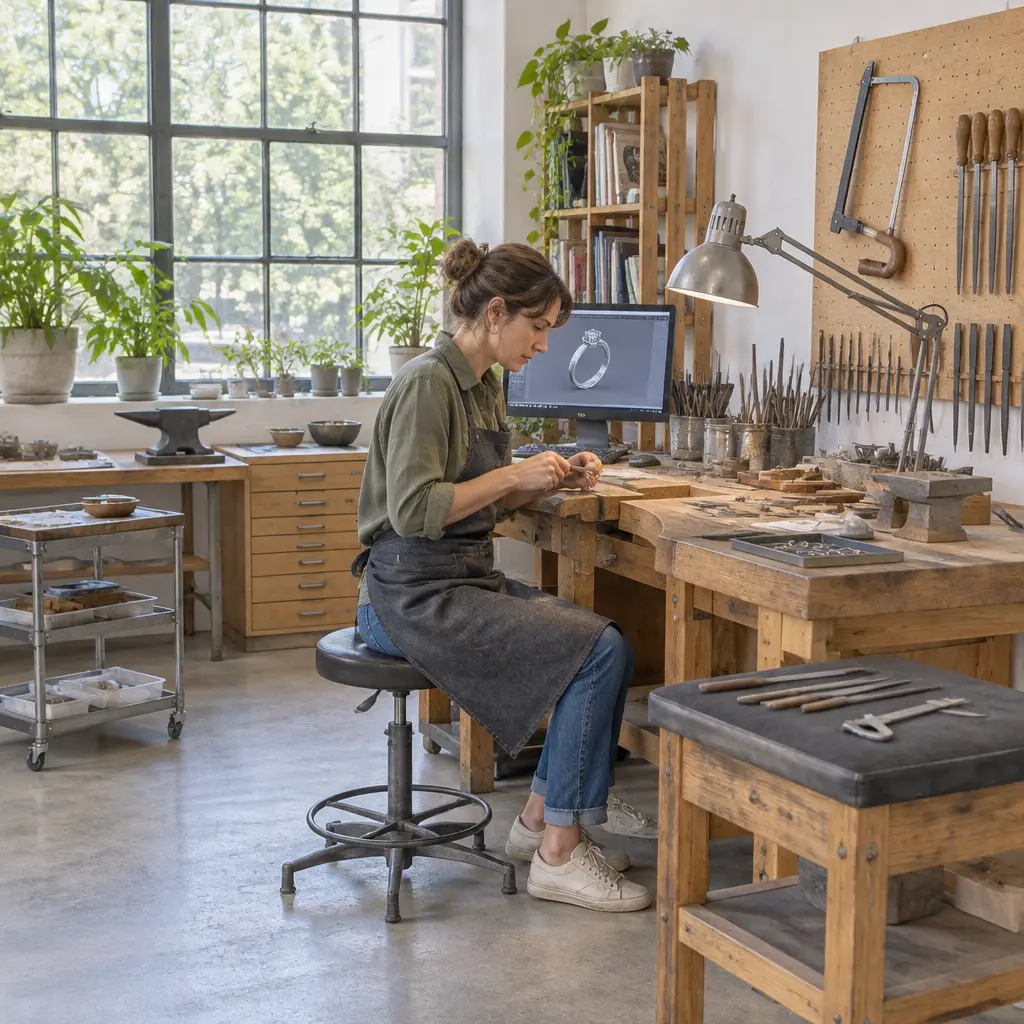
Jewelry making combines hand skills and specialized tools to shape, join, finish, and set materials such as precious metals and gemstones. Traditional tools—including the jeweler’s saw, files, stakes, and soldering equipment—remain essential, while digital design, laser welding, and computer-controlled cutting have expanded precision and repeatability. The U.S. Bureau of Labor Statistics counted about jewelers and precious stone and metal workers in its 2023 occupational data; the work’s continuing mix of craft and technology makes understanding both toolsets useful for makers, studios, and consumers. This guide defines the role of jewelry-making tools, explains traditional and modern categories, and compares their applications, limits, and safety considerations.
Tools and methods in jewelry making
A jewelry-making tool is an instrument or machine used to transform, join, shape, decorate, or inspect materials during the production or repair of wearable objects. The American Gem Society describes jewelry work as a combination of specialized skills and equipment, with processes varying according to the material and design. Tools are therefore best understood by the task they perform: forming, cutting, joining, finishing, setting, or measuring.
Traditional tools are generally operated directly by the craftsperson and provide tactile control. Modern tools may add powered motion, optical magnification, digital design, or automated accuracy. These categories overlap: a contemporary workshop may use a hand saw to refine a component designed in CAD, then solder it with a torch and finish it using a rotary tool.
Traditional hand tools
Traditional hand tools are manually controlled instruments used for cutting, forming, holding, and finishing. A jeweler’s saw, for example, uses a narrow replaceable blade held in a frame to cut sheet metal and make pierced patterns. Files remove small amounts of material and refine edges, while pliers, hammers, mandrels, and stakes help bend or form metal. Their defining characteristics are direct feedback, relatively low setup cost, and dependence on practiced technique.
These tools suit one-off work, delicate adjustments, and tasks where the maker benefits from feeling resistance in the material. Their limitations include slower production for repeated components and results that can vary with the user’s skill. The Victoria and Albert Museum’s jewelry collections offer historical examples of how hand processes and specialist tools have supported ornamental metalwork across different periods.
Modern powered and digital tools
Modern jewelry tools include powered rotary handpieces, laser welders, digital microscopes, computer-aided design (CAD) software, and computer-controlled manufacturing systems. A rotary handpiece can drive burs and polishing attachments; a laser welder delivers concentrated energy to join or repair small areas; CAD allows a designer to construct and revise a three-dimensional model before producing a physical piece.
Digital tools can improve repeatability and make complex geometry easier to prototype, but they do not remove the need for material knowledge or finishing skill. CAD models may be produced through resin printing and casting or through other manufacturing routes; each introduces its own tolerances and finishing requirements. The Gemological Institute of America discusses technological change in gem and jewelry work, including how new equipment supplements rather than replaces specialist judgment.
Traditional tools shape jewelry through direct craft
Traditional jewelry tools are hand-operated or manually controlled devices that let makers remove material, form metal, and assemble components through direct physical action. This tool group includes cutting tools, forming tools, joining equipment, and finishing instruments. The practical advantage is adaptability: a skilled maker can make small corrections while responding to the behavior of the metal or stone.
The methods are not simply historical. Hand tools remain central in modern repair, custom fabrication, stone setting, and finishing, often alongside powered equipment. Their effectiveness depends on selecting the correct tool, maintaining it, and using suitable protective equipment.
Cutting and piercing tools
Cutting and piercing tools separate material or create openings. The jeweler’s saw is used for cutting sheet metal and internal shapes; shears and snips handle suitable sheet stock, while drills and burs create holes. Choosing a blade or cutting attachment appropriate to the material and thickness helps control the cut and reduce breakage.
Sawing also illustrates the importance of supporting work securely. A bench pin provides a stable surface and a notch for the blade, while controlled strokes help avoid buckling thin sheet. For repeated or intricate cuts, laser cutting or waterjet services may be considered, but traditional sawing remains valuable for hand adjustment and small-scale work.
Forming and shaping tools
Forming tools change a material’s shape without necessarily removing it. Jewelers use chasing hammers, planishing hammers, mallets, mandrels, stakes, and pliers to create curves, flatten surfaces, and shape rings or bezels. Different hammer faces and stakes produce different surface effects, so the tool and striking technique influence both form and finish.
Metalworking can work-harden metal, making it less ductile as it is repeatedly deformed. Makers may need to anneal appropriate metals using controlled heating and cooling procedures before continuing to form them. Because alloys behave differently, reliable workshop references and material-specific instruction are important; overheating can damage a piece or create safety hazards.
Soldering and assembly tools
Soldering tools join metal components by heating them and using a filler alloy that flows into the joint. A jeweler’s torch, soldering block, tweezers, and suitable flux are common components of a bench setup. Correct joint fit and heat control matter: solder must reach its flow temperature, while the main components should remain properly aligned and avoid unnecessary overheating.
Soldering is distinct from welding, which joins materials by melting or fusing the parent material at the joint. Traditional torch soldering remains practical for many fabrication tasks, while laser welding can target a small area and may be useful for repairs near heat-sensitive components. The choice depends on the alloy, construction, nearby stones, and required joint strength.
Finishing and stone-setting tools
Finishing tools refine surfaces and edges, while stone-setting tools secure gems in a mounting. Files, abrasive papers, polishing buffs, and burnishers are used at different stages of surface preparation. Setting tools include gravers, punches, bezel pushers, and prong tools, selected according to the setting style and gemstone.
Finishing is a sequence rather than a single operation: scratches left by a coarse abrasive must be removed progressively before polishing can create a consistent sheen. Stone setting likewise requires close inspection, because excessive pressure or poorly supported stones can cause damage. Magnification and good lighting improve visibility but do not replace careful technique.
Modern tools increase precision and repeatability
Modern jewelry tools use powered, optical, digital, or automated systems to control production steps. They can support repeatable dimensions, speed up certain processes, and enable designs that are difficult to make by hand alone. Their benefits are strongest when matched to a clear production need; purchasing sophisticated equipment without training, maintenance planning, or adequate ventilation can add cost and risk without improving results.
A useful way to evaluate these tools is to consider the workflow stage they affect: design, prototyping, fabrication, joining, inspection, or finishing. In many workshops, the most effective approach is hybrid rather than purely manual or fully automated.
CAD and 3D printing
CAD software creates a digital model that can be measured, revised, and prepared for manufacture. Three-dimensional printing can turn a model into a prototype or a castable pattern, depending on the printer material and production process. These tools are useful for testing proportions, creating repeatable components, and exploring complex forms before committing to precious metal.
A digital model is not automatically a production-ready object. Designers must account for wall thickness, casting shrinkage, support structures, stone-setting clearances, and the finishing allowance required after manufacture. The National Institute of Standards and Technology describes additive manufacturing as a family of processes that build objects from digital models, with process-specific capabilities and limitations—an important distinction for jewelry workflows.
Laser welding and precision equipment
Laser welders focus energy into a small spot to fuse metal, making them useful for localized repairs and precise joins. Compared with broad torch heating, this localized energy can reduce heat exposure to nearby areas in suitable applications. However, laser welding requires training, correct parameter selection, eye protection, and equipment designed for the task.
Other precision equipment includes digital calipers, microscopes, and powered engraving systems. These tools help measure, inspect, or reproduce details, but readings and images are only useful when the equipment is calibrated and the operator understands its limits. For gemstone work, heat sensitivity and internal features must be considered before choosing any joining or finishing method.
Rotary tools and mechanized finishing
Rotary tools use a motor-driven handpiece to operate burs, drills, abrasive points, and polishing attachments. They can speed up repetitive tasks and reach small areas, but high speed can remove material quickly or generate heat. Makers should select attachments rated for the machine, secure the work, and use eye protection and appropriate dust control.
Mechanized polishing can improve consistency across batches, while hand finishing remains useful for edges, transitions, and areas that require close control. A practical workflow often combines machine efficiency with manual inspection and corrective finishing.
Choosing between traditional and modern jewelry tools
Tool selection depends on the material, design complexity, production volume, budget, skill level, and safety setup. Traditional tools tend to offer lower entry costs and direct control; modern equipment can improve speed, precision, or repeatability but may require substantial investment and technical training. Neither category is universally superior.
Match the tool to the task
For a one-off ring or a small repair, hand tools may be efficient and flexible. For repeated components or intricate digital forms, CAD and outsourced or in-house additive manufacturing may reduce repeated manual layout. A laser welder may be suitable for a localized repair, whereas a torch may be better for a broader soldering operation. The best choice is the method that meets the design and material requirements safely and reliably.
Consider cost, training, and maintenance
The purchase price is only one part of a tool’s cost. Powered and digital systems may also require consumables, servicing, software, ventilation, protective equipment, and operator training. Hand tools require sharpening, replacement blades, and upkeep, but are generally simpler to maintain. Studios should compare total operating costs with expected workload and the value of improved consistency or time savings.
Build a safe and responsible workspace
Jewelry work can involve sharp edges, heat, rotating machinery, airborne particles, chemicals, and intense light. The U.S. Occupational Safety and Health Administration emphasizes hazard assessment and appropriate controls in workplaces. In practice, jewelers should use task-appropriate eye protection, ventilation or local exhaust, secure workholding, and safe procedures for torches, polishing, and chemical handling. Safety guidance should be specific to the equipment and materials in use.
A workshop comparison chart could map each tool to its main task, precision, setup cost, and principal hazards—for example, hand saw versus laser cutter, torch versus laser welder, and hand polishing versus mechanized polishing. Such a chart helps makers identify where a modern tool adds meaningful value and where a traditional method remains the more practical choice.
Conclusion: combine craft knowledge with suitable technology
Traditional jewelry tools support direct, adaptable work in cutting, forming, soldering, finishing, and setting. Modern tools such as CAD, 3D printing, laser welding, and powered rotary systems can expand precision and repeatability, especially in complex or repeated production. The strongest workshops understand the capabilities and limitations of both, selecting tools according to materials, design, workflow, and safety needs.
For makers, the next step is to identify a specific bottleneck—design iteration, repetitive cutting, difficult repairs, or finishing—and evaluate whether a hand tool, powered tool, or digital process addresses it. Consult equipment manuals, reputable technical training, and workplace safety guidance before adopting unfamiliar processes. Jewelry making remains a craft shaped not by tools alone, but by informed choices and skilled hands.
Sources: U.S. Bureau of Labor Statistics, Occupational Employment and Wage Statistics, Jewelers and Precious Stone and Metal Workers, https://www.bls.gov/oes/; American Gem Society, Jewelry Careers and Education, https://www.americangemsociety.org/; Victoria and Albert Museum, Jewellery Collection, https://www.vam.ac.uk/collections/jewellery; Gemological Institute of America, Jewelry Technology and Manufacturing resources, https://www.gia.edu/; National Institute of Standards and Technology, Additive Manufacturing, https://www.nist.gov/additive-manufacturing; U.S. Occupational Safety and Health Administration, Personal Protective Equipment, https://www.osha.gov/personal-protective-equipment.