
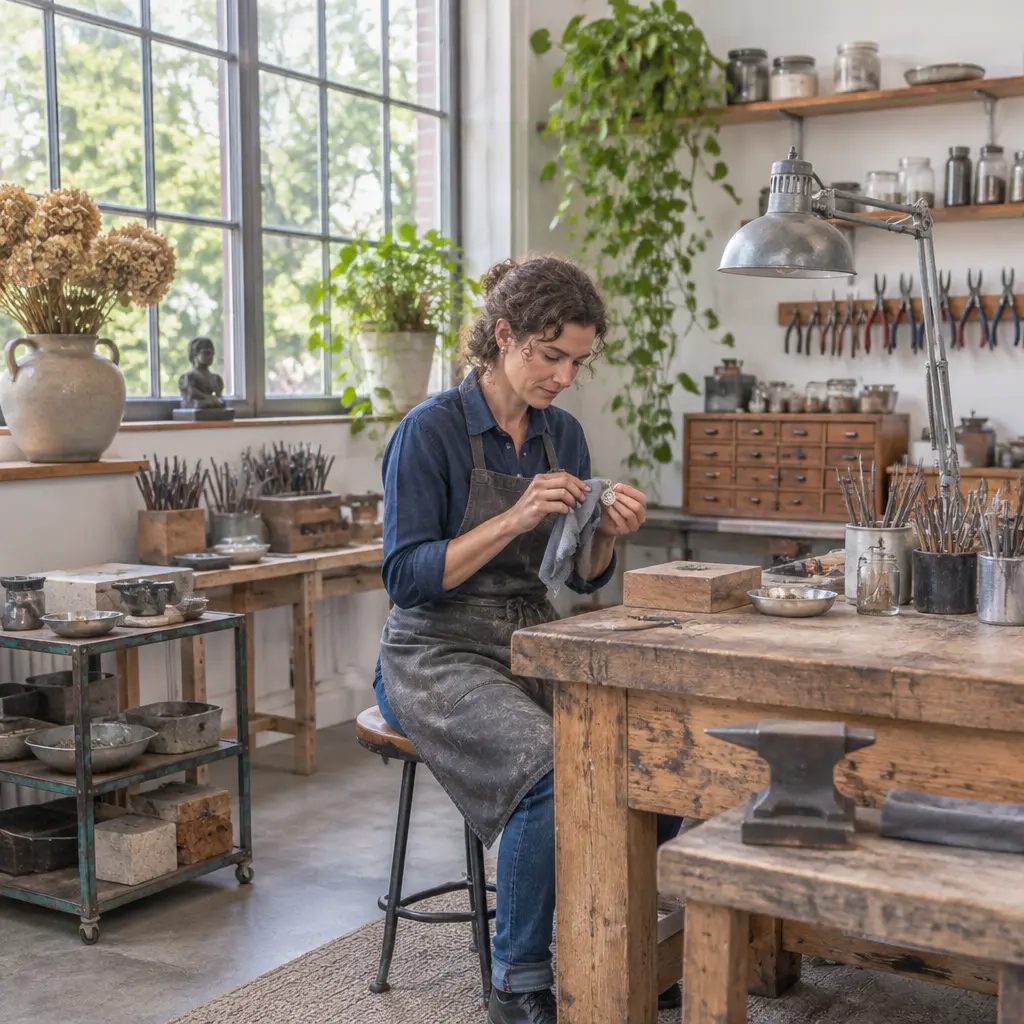
Handmade jewelry is jewelry made through hands-on design and production, often with tools and techniques selected for a particular material or piece. It takes time because a maker must plan the design, prepare and shape materials, assemble components, and finish and inspect the result—steps that may be repeated or adjusted when a piece does not meet the intended standard. The time involved varies widely with complexity, materials, and production method. The U.S. Bureau of Labor Statistics describes jewelers and precious-stone and metal workers as people who use tools and equipment to create or repair jewelry, but it does not set a standard time for a handmade item. Understanding the process—from design and fabrication to finishing and quality checks—helps explain why careful craftsmanship cannot always be rushed.
Handmade Jewelry Production Requires Multiple Stages
Handmade jewelry production is the sequence of creative and technical tasks used to turn a design and raw or prepared materials into a wearable object. The Smithsonian Institution’s National Museum of American History documents jewelry as both adornment and material culture, while the U.S. Bureau of Labor Statistics notes that jewelry work involves making and repairing pieces with specialized tools. Neither source assigns a universal production time: a simple pair of earrings and a stone-set ring demand different amounts of labor.
Common forms of handmade production include bench work in metal, bead stringing, wirework, enameling, stone setting, and mixed-media assembly. These methods differ in preparation, tool use, and opportunities for correction. A maker may also combine them—for example, fabricating a metal pendant, setting a stone, and adding a hand-finished surface. That combination of processes is one reason an apparently small piece can require many separate operations.
Design and Planning
Design and planning translate an idea into a workable object. A jeweler may sketch proportions, choose materials, consider how the piece will sit on the body, and decide how components will connect. For a custom piece, the process can also include discussion of the wearer’s preferences, measurements, budget, and revisions. The design stage matters because decisions made here affect later fabrication: a change in stone size, for example, can require a different setting or alter the dimensions of the surrounding metal.
Planning is not always a single, uninterrupted step. Makers often test a construction idea, revise a drawing, or create a sample before committing valuable materials. This is especially useful when a design includes moving parts, unusual proportions, or several linked components. The more interdependent the elements are, the more important it becomes to resolve their fit before assembly.
Material Preparation and Fabrication
Fabrication is the process of shaping and joining material to form jewelry components. Depending on the design, a metalsmith may saw, file, bend, form, solder, or texture metal; a beadworker may sort, measure, and arrange beads; and a wireworker may shape and wrap wire by hand. Each technique has its own demands, and careful preparation helps prevent avoidable defects during later assembly.
Material behavior also affects working time. Metal thickness, hardness, and shape influence how it can be formed, while natural stones and pearls vary in size, color, and surface characteristics. A maker may need to adapt a design to the actual materials available rather than treat every component as identical. In a stone-set piece, for instance, the setting must be fitted to the stone, not merely to a generic measurement.
Assembly and Stone Setting
Assembly joins prepared components into a finished structure. It may involve soldering metal parts, connecting chains and clasps, weaving or wrapping elements, or securing a stone in a setting. Stone setting is a particularly precise operation: the setting must hold the stone securely while allowing it to sit correctly and remain visually balanced. A mismatch may require adjustment before the piece can proceed to finishing.
Assembly time grows when a design contains many connections or requires close alignment. A pendant with one simple bail has fewer assembly points than a linked bracelet with repeated joints. Each connection is also a potential point of weakness, so a maker must consider strength and wearability as well as appearance.
Handmade Jewelry Finishing Determines Wearability and Appearance
Finishing is the set of operations that refine a piece after its main components have been made and assembled. It can include filing, sanding, polishing, cleaning, applying a surface treatment, and checking edges and connections. Finishing is not merely decorative: smooth edges and sound closures help make jewelry comfortable and practical to wear.
The finish depends on the maker’s intended look and the material. A polished surface, a brushed texture, and an oxidized finish call for different treatments. Some work may also require repeated cycles—for example, refining a surface, inspecting it under good light, and correcting marks before the final polish. As a result, the visible simplicity of a finished piece does not necessarily indicate how many careful steps went into it.
Surface Finishing and Detail Work
Surface finishing improves a jewelry piece’s texture, luster, and small-scale details. Filing removes excess material and sharp edges; sanding reduces tool marks; polishing creates a reflective surface; and other treatments can produce matte or colored effects. A maker may work through more than one grade of abrasive or use different tools for different areas, particularly when the design includes both broad surfaces and tight recesses.
Detail work also includes tasks such as aligning decorative elements, checking a clasp’s movement, and making sure a setting does not snag. These checks connect appearance to function. A piece may look complete at a glance yet still need refinement to feel comfortable or operate reliably.
Inspection, Testing, and Rework
Inspection is the review of a finished or partly finished piece for workmanship, fit, and function. A maker can examine joints, stone security, symmetry, surface quality, and closures. If an issue appears, rework may involve reopening a joint, adjusting a setting, or repeating part of the finishing process. Such corrections add time, but they are part of producing a piece that meets the maker’s standard.
The National Institute of Standards and Technology explains measurement traceability and reliable measurement practices in manufacturing contexts; jewelry makers similarly depend on accurate measurements when dimensions and fit matter. This does not mean every craft studio uses industrial testing equipment. Rather, it highlights a broader principle: checking dimensions and performance is essential when precision affects the final product.
Materials, Complexity, and Customization Change Production Time
The time required for handmade jewelry depends on the interaction of materials, design complexity, production method, and order requirements. There is no reliable single estimate for all handmade work. A straightforward bead bracelet may be assembled relatively quickly, while a custom ring with a fitted stone, detailed engraving, and a polished finish can involve several distinct stages and opportunities for revision.
These factors also explain why handmade production is not always directly comparable with factory production. The U.S. Bureau of Labor Statistics distinguishes jewelry craft work from mass production by describing workers who make and repair pieces using specialized skills and tools. A workshop may use equipment, but individual design choices and hand-finishing can still make production less standardized than a high-volume line.
Material Properties and Sourcing
Material properties influence how jewelry can be formed, joined, and finished. Precious metals, base metals, gemstones, glass, wood, and textiles each require suitable handling and tools. The time needed to source or prepare materials can also vary, particularly when a design calls for a specific stone, unusual color, or matching set of components. The Gemological Institute of America’s educational resources explain that gemstones are evaluated through characteristics such as color, clarity, cut, and carat weight, helping illustrate why stones that appear similar can differ in appearance and suitability.
For makers, material selection is therefore both a design decision and a production decision. A stone’s shape may affect the setting; a metal’s surface may influence the final texture; and natural variation may require components to be matched by eye. Choosing carefully at the beginning can reduce avoidable changes later, but it also takes attention and expertise.
Design Complexity and Custom Orders
Design complexity is the number and difficulty of the operations required to make a piece. Multiple components, repeated links, intricate patterns, moving parts, and stone settings can all increase the work involved. Custom orders may add consultation, measurement, sketches, approval, and revisions. Because customer preferences can change during development, makers may need to revisit decisions before fabrication is complete.
A practical example is a made-to-order ring. The maker may first confirm the design and ring size, then prepare the band, create or adapt the setting, fit the stone, refine the surface, and inspect the finished piece. If the stone or sizing changes, some earlier work may need to be adjusted. The example shows why delivery time includes more than the minutes spent shaping metal: it can also include planning, communication, and quality control.
Small-Batch Work and Maker Capacity
Small-batch production means making a limited number of pieces rather than producing a large, standardized run. A maker may need to repeat preparation and finishing tasks for each item, even when the designs are similar. Workshop capacity, order volume, equipment availability, and time reserved for custom work can all affect when an order is completed.
This distinction helps explain why a handmade item’s lead time is not always the same as its active bench time. A jeweler may work on several commissions in sequence, wait for a needed component, or schedule work around other pieces. Customers can ask makers to distinguish estimated production time from total order lead time and to clarify whether design approval or material sourcing is still pending.
Conclusion: Time Supports Handmade Jewelry’s Quality and Character
Handmade jewelry takes time because it brings together design and planning, material preparation, fabrication, assembly, finishing, and inspection. Each stage can change according to the materials, the complexity of the piece, and whether it is made to order. These factors make a universal production-time estimate misleading, while careful finishing and rework help support appearance, fit, and durability.
When commissioning or buying handmade jewelry, ask the maker what stages are involved, what affects the schedule, and whether the quoted timeframe covers production alone or the full lead time. Understanding the process makes it easier to value the skill behind a finished piece—and to make informed choices about design, materials, and delivery expectations.
Sources: U.S. Bureau of Labor Statistics, Jewelers and Precious Stone and Metal Workers, https://www.bls.gov/ooh/production/jewelers-and-precious-stone-and-metal-workers.htm; Smithsonian Institution, National Museum of American History, Jewelry, https://americanhistory.si.edu/collections/object-groups/jewelry; National Institute of Standards and Technology, Metrology, https://www.nist.gov/metrology; Gemological Institute of America, Gem Encyclopedia, https://www.gia.edu/gem-encyclopedia.


